
The mortgage industry has always had a scaling problem.
When volumes surge, lenders hire. Aggressively. They compete for experienced processors and underwriters, pay premium rates to fill seats, and spend weeks training new staff on their proprietary workflows and customized loan origination systems. By the time the new hires are productive, the volume surge has subsided.
And when volumes decline, lenders let those hires go. Tens of thousands of mortgage professionals lost their jobs after the 2022 rate increases collapsed origination volumes by nearly 60%. Severance costs, bloated overhead, institutional knowledge walking out the door; the same lenders who had been hiring twelve months earlier were now cutting.
This hire-and-fire cycle has defined mortgage operations for decades, an inevitable consequence of running a people-only operating model in a market where loan volumes are inherently unpredictable three months out.
And, because interest rate movements are volatile—a Fed decision, an inflation spike, or a geopolitical event—origination pipelines can swing by 30% or more in a single quarter. Can a lender reasonably forecast the staffing levels they’ll need three months from now?
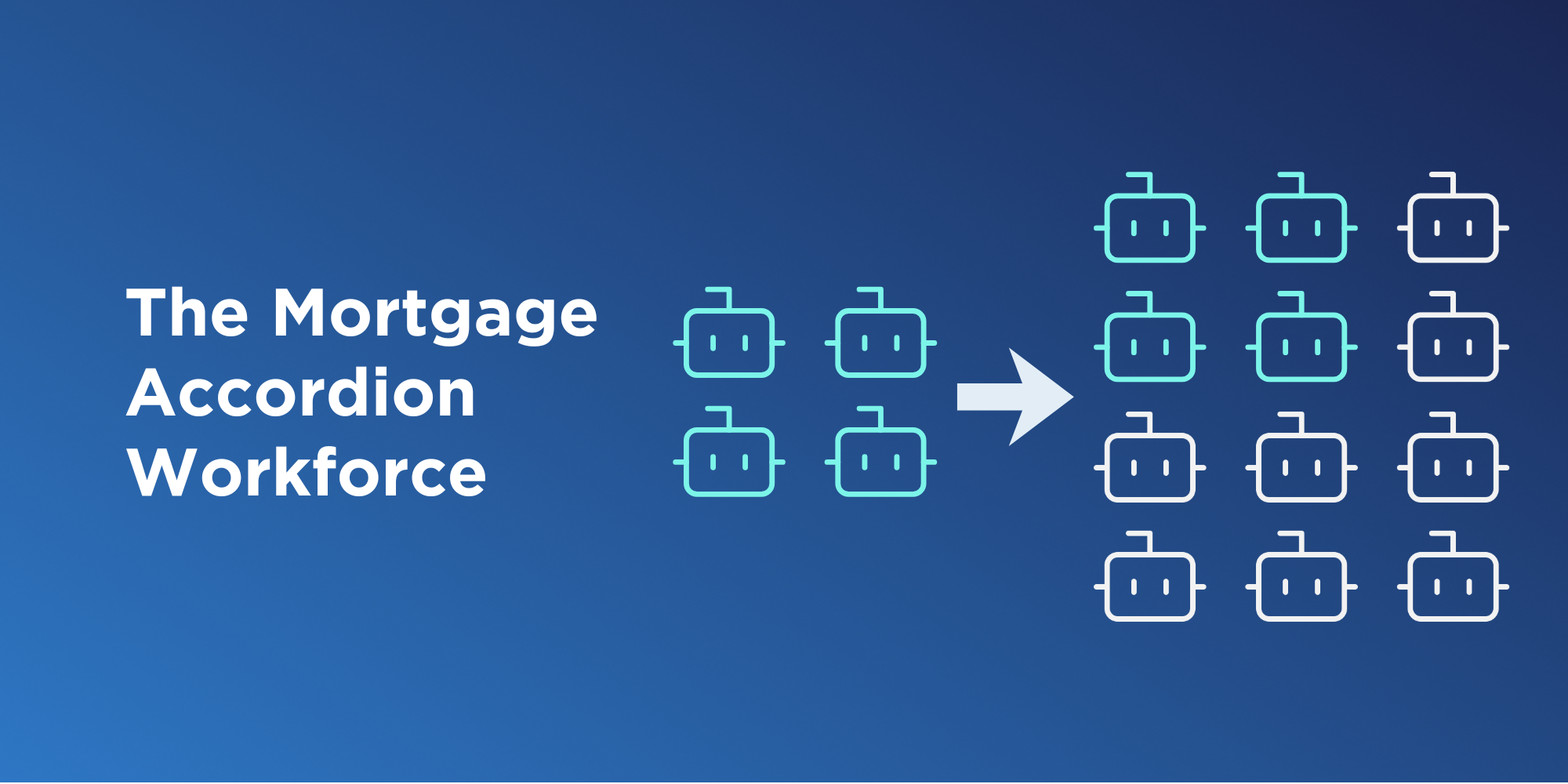
But there is a different way to operate. MOZAIQ calls it the Accordion Workforce.
What is the Accordion Workforce?
The Accordion Workforce is a digital operating model where core automation infrastructure expands and contracts with loan volume at the touch of a few keystrokes, without the lag, cost, and organizational and cultural damage of hiring and firing human resources.
When volumes increase, additional virtual machines are provisioned, and the platform scales in line with volume by adding more digital workers—AI agents and automation functions—absorbing the incremental volume without requiring proportional increases in hires. When volumes decline, the platform scales down. No layoffs. No severance. Reduced excess overhead i.e., fixed costs. Institutional knowledge is maintained. And no rebuilding when volumes recover.
The experienced human professionals—underwriters, senior processors, compliance staff—continue to focus on high-value tasks and credit decisions, while the automation handles the mundane and routine, like document indexing, data validation, stare and compare functions, and rules-based processing.
The Proof Point: A Top Five Lender’s Transformation
A top five wholesale lender incrementally deployed MOZAIQ’s Loan Assist platform across their loan fulfillment lifecycle—from document indexing through investor loan delivery. Over a four-year partnership, the lender automated back-office processes using a phased approach, starting with high-volume, rules-based functions and extending to more complex processes once ROI was proven.
When the lender acquired another company’s origination channel assets, it faced a projected tenfold increase in volume within twelve to eighteen months. No technology was transferred. Only a small operations team came over as part of the transaction.
A traditional lender would have faced significant staffing challenges: hire new resources, with months of recruiting and training before they could be productive. Instead, the wholesale lender provisioned additional virtual machines, deployed more digital workers, and extended automation to upstream and downstream processes. The Accordion Workforce expanded with the business.
The results: from $10 million to $2 billion in monthly originations in under two years. A 100% increase in productivity. Loan turn times improved by more than 50%. And as volume grew nearly 8x, personnel cost per loan declined 40%.
Why This Matters Now
The MBA’s Q3 2025 highlights an industry operating on razor-thin margins: 33 basis points per loan. The average cost to originate is $11,109 per loan, with personnel consuming nearly 60% of that total cost. Fulfillment productivity has flatlined at 5.24 closings per employee per month, unchanged in two years.
And when interest rates decline unlocking refinance volume, lenders in the market will face the same question: can they absorb the increase?
The lenders running a people-only model will scramble to hire, compete for scarce talent, pay premium rates, and spend months getting new staff to be productive. They will lose to competitors who close faster during the ramp and maintain superior customer service levels. And when volumes normalize, these traditional lenders will have to reduce staff, repeating the cycle that has eroded margins and destroyed competitive advantage in prior upturns.
The lenders who deploy the Accordion Workforce will press a button. Volume will be absorbed. Service levels will be maintained. Per loan margins will increase. Market share will be gained.
A Different Operating Model
The Accordion Workforce reframes automation from a cost-cutting exercise to something more fundamental: a structurally different way to operate a mortgage business. It’s not about replacing people. It’s about building an operating model where ability to scale is no longer constrained by the lender’s ability to predict the unpredictable and hire fast enough to compete.
Automation and agentic mortgage AI solutions exist today. They are in production. The question is whether mortgage lenders will adopt these before the next volume swing forces their hand.
Ready to see what MOZAIQ can do for your operation? Schedule a conversation with our team.